


Sam Sulek Workout Routine: The High-Volume 4-Day Split Behind the Physique
If you searched for the Sam Sulek workout routine, you probably want more than a recycled list of exercises. You want the actual structure: how he splits training, how often he hits each muscle, what intensity style he uses, and what parts of his approach are worth borrowing without burning yourself into the ground.
Sam Sulek’s training stands out because it blends old-school bodybuilding volume, modern machine and cable bias, and a simple but brutal principle: take hard sets seriously. He doesn’t make the process look complicated. He just shows up, trains with intent, eats to recover, and repeats.
For performance-driven lifters, that’s the appeal. But copying a pro bodybuilder blindly is a mistake. At Routines Club, we break down elite routines independently, then translate them into something you can actually use in real life.
In this guide, you’ll get:
- Sam Sulek’s core 4-day rotating split
- Exercise selection and session design
- Training principles that make his routine work
- Recovery, cardio, and supplement considerations
- A realistic version for intermediate lifters

What Makes Sam Sulek’s Workout Routine Different?
Most mainstream workout plans are built around neat calendars and fixed rest days. Sam’s system is different.
He typically runs a 4-day bodybuilding rotation:
- Chest + side delts
- Back + rear delts
- Arms
- Legs
Then he repeats the cycle, taking rest when recovery actually demands it rather than because a calendar says so.
That creates a few defining traits:
- High frequency without a traditional 7-day split
- High effort, often to failure or near-failure
- Moderate-to-high volume per body part
- Heavy use of machines, cables, and controlled reps
- Daily or near-daily low-intensity cardio
Competitor content usually stops there. The real insight is why this works: Sam’s sessions are organized around muscle stimulus efficiency, not exercise variety for its own sake. He uses movements that let him keep tension where he wants it, especially when fatigue gets high.
The Core Sam Sulek 4-Day Training Split
Weekly Structure
Because this is a rotating split, it doesn’t fit neatly into Monday-Sunday planning. But in practice, most people experience it like this:
| Training Day | Focus | Typical Goal |
|---|---|---|
Day 1 | Chest + Side Delts | Upper chest thickness, chest pump, shoulder width |
Day 2 | Back + Rear Delts | Width, thickness, rear delt detail |
Day 3 | Arms | Biceps and triceps volume, pump, controlled eccentrics |
| Day 4 | Legs | Quads, hamstrings, calves |
| Ongoing | Daily LISS Cardio | Recovery support, conditioning, calorie expenditure |
Visual Overview
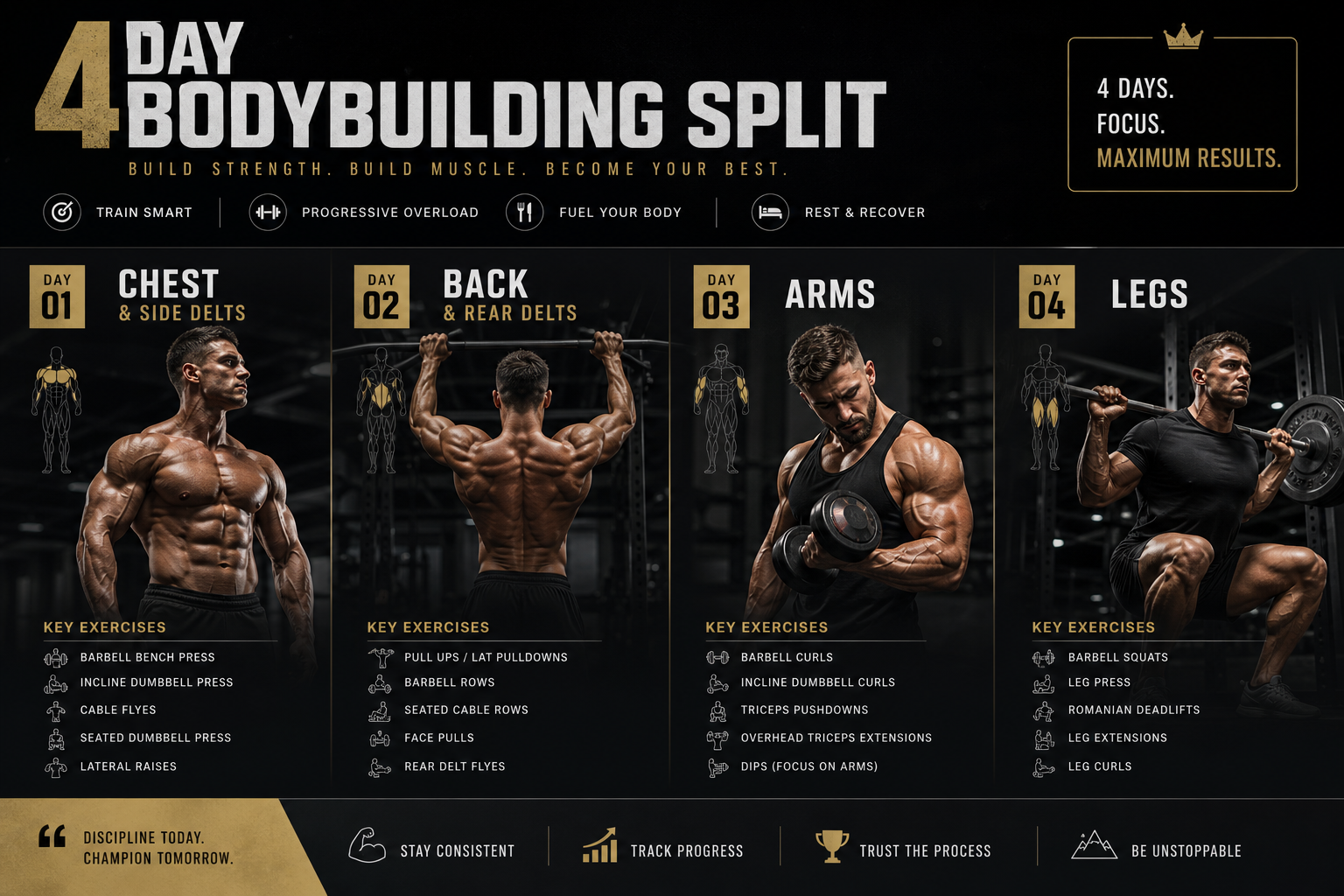
Sam Sulek Workout Routine: Full Breakdown
Day 1: Chest and Side Delts
Sam tends to prioritize incline pressing and chest movements that bias the upper chest. That lines up with his physique goals and classic bodybuilding look.
Sample Chest + Side Delt Session
| Exercise | Sets | Reps | Notes |
|---|---|---|---|
Incline Barbell or Dumbbell Press | 3-4 | 8-12 | Main upper chest compound |
| Machine Chest Press | 2-3 | 8-12 | Stable pressing under fatigue |
Pec Deck Fly | 2-4 | 10-15 | Controlled squeeze and stretch |
Cable Fly Variation | 1-3 | 12-15 | Often used to finish |
| Cable Lateral Raise | 3-4 | 12-15 | Constant tension |
| Machine or Dumbbell Lateral Raise | 2-3 | 12-15 | Pump-focused |
Why this session works
The chest work moves from heavier compounds into lengthened and shortened-position isolation work. Then side delts get direct volume while chest fatigue is no longer a limiting factor.
That sequencing matters. Many lifters bury their shoulder work inside a generic push day and never give side delts enough quality effort.
Day 2: Back and Rear Delts
Back training in Sam’s style is less about chasing numbers and more about targeting lats and upper back with deliberate pulling mechanics.
Sample Back + Rear Delt Session
| Exercise | Sets | Reps | Notes |
|---|---|---|---|
Wide-Grip Lat Pulldown | 3-4 | 8-12 | Width focus |
Seated Cable Row | 3-4 | 8-12 | Mid-back thickness |
Single-Arm Row | 2-3 | 10-12 | Helps improve symmetry |
Chest-Supported Machine Row | 2-3 | 10-12 | Less lower-back fatigue |
| Straight-Arm Cable Pulldown | 2-3 | 12-15 | Lat isolation |
| Rear Delt Cable Fly | 3-4 | 12-15 | Controlled rear delt work |
| Reverse Pec Deck | 2-3 | 12-15 | Finish with high tension |
What most people miss about Sam’s back training
It’s not just “do rows and pulldowns.” The key is that he often chooses movements that reduce momentum and make it harder for stronger muscles to take over. That is one reason machines and cables show up so often in modern bodybuilding.
Day 3: Arms
Arm day is one of the clearest examples of Sam’s training style: slow eccentrics, full range of motion, and relentless local fatigue.
Sample Arms Session
| Exercise | Sets | Reps | Notes |
|---|---|---|---|
Rope Tricep Pushdown | 3-4 | 10-12 | Elbow-friendly starter |
Overhead Cable Tricep Extension | 2-3 | 10-12 | Long-head emphasis |
| Dips or Dip Machine | 2-3 | 10-15 | Compound triceps finisher |
EZ-Bar Curl | 3-4 | 8-12 | Controlled lowering |
Barbell Curl | 2-4 | 8-12 | Heavier biceps work |
Hammer Curl | 2-3 | 10-12 | Brachialis and forearms |
| Incline Dumbbell Curl | 2-3 | 10-12 | Stretch-focused biceps |
| Cable Curl | 2-3 | 12-15 | Constant tension finisher |
Why his arm training gets attention
Sam’s arm sessions highlight a principle many lifters forget: hypertrophy rewards precision. You don’t need circus variation. You need a small number of movements done with high intent.
Day 4: Legs
Sam’s leg training often mixes compounds with machine-based isolation. He’s also known for valuing exercises like leg extensions and leg curls, which many lifters underrate.
Sample Legs Session
| Exercise | Sets | Reps | Notes |
|---|---|---|---|
Leg Extension | 2-3 | 15-20 | Warm-up and pre-fatigue |
Back Squat, Hack Squat, or Smith Front Squat | 3-4 | 8-12 | Main quad pattern |
| Leg Press | 3-4 | 10-15 | Higher-volume compound |
Leg Extension | 2-4 | 10-15 | Working sets |
Lying Leg Curl | 3-4 | 10-12 | Hamstring focus |
Seated Leg Curl | 2-3 | 10-12 | Different hamstring profile |
| Standing Calf Raise | 3-4 | 15-20 | Stretch and full contraction |
| Seated Calf Raise | 2-3 | 15-20 | Soleus work |
Why this leg setup is effective
This style balances:
- Technical lifts for systemic overload
- Stable machine work for high local fatigue
- Enough hamstring and calf isolation to avoid a quad-only leg day
Training Principles That Actually Drive Results
1. He trains hard, not just often
A huge theme across competitor articles is “Sam trains almost every day.” True, but incomplete.
The more important point is that his routine depends on hard working sets, often taken to failure or very near failure. Frequency without intensity is just activity.
“Creatine supplementation during resistance training has been shown to increase lean body mass by an average of 1.1 kg.” – Source
2. He uses controlled eccentrics
Sam’s reps are often slower on the lowering phase. That helps with:
- Positioning
- Tension control
- Muscle targeting
- Making lighter-to-moderate loads more effective
3. He favors stable exercises when fatigue is high
This is one of the biggest content gaps in competitor posts. They mention machines, but not why they matter.
Machines and cables let advanced bodybuilders:
- Push closer to failure more safely
- Keep tension on the target muscle
- Reduce coordination demands late in the session
- Recover from high output more predictably
4. He uses enough volume, but not random volume
Some competitor pages portray Sam as doing endless junk volume. That misses the nuance.
He often lands in a zone of roughly 8-12 hard sets per muscle group per session, depending on the body part and exercise choice.
“About 10 weekly sets per muscle group may lead to near-maximal hypertrophy gains for many lifters.” – Source
This doesn’t mean everyone should chase maximum sets. It means the routine works because there is enough quality volume, not because there is magic in exhaustion alone.
5. He autoregulates instead of following rigid periodization
Sam doesn’t seem obsessed with textbook progression models. He adjusts based on feel, recovery, and what the session gives him.
That can work very well for advanced lifters, but it’s also where most people misapply his style. Autoregulation works best when you already know what productive effort feels like.
Does Sam Sulek Do Cardio?
Yes, and this is one of the most useful parts of his system for regular lifters.
He is widely associated with:
- 30 minutes of low-intensity steady-state cardio
- Often on a stationary or recumbent bike
- Typically separated from lifting when possible
Why the cardio matters
For bodybuilding-focused lifters, cardio can improve:
- Work capacity
- Recovery between sets
- Appetite management
- General cardiovascular health
- Body composition control during gaining phases
This is another place where Routines Club’s approach matters. Instead of treating routines like celebrity cosplay, we focus on what fits into real schedules. For most readers, 20-30 minutes of easy cardio 4-6 times per week is the takeaway worth stealing.
What Supplements Are Associated With Sam Sulek?
Competitor content consistently mentions a practical stack built around basics rather than exotic formulas.
Commonly Mentioned Supplements
| Supplement | Primary Purpose | Typical Timing |
|---|---|---|
Creatine Monohydrate | Strength, power, lean mass support | Daily |
Pre-Workout | Energy, focus, training output | 20-30 min pre-lift |
Whey Protein | Convenient protein intake | Post-workout or between meals |
| Electrolytes | Hydration and performance support | Morning or pre/intra workout |
| Fish Oil | Joint and general health support | With meals |
| Intra-Workout Aminos | Optional recovery/performance support | During longer sessions |
Best-practice note
If you want the highest ROI stack, start here:
- Creatine monohydrate
- Protein powder if needed
- Electrolytes if you train hard or sweat heavily
- Pre-workout only if useful
- Fish oil if dietary intake is low
That evidence-informed filtering is exactly how we approach supplement analysis at Routines Club: cut the noise, prioritize dose and utility, and make it fit real life.
How Sam Sulek Likely Progresses
One major gap in competitor coverage is progression. They list exercises, but rarely explain how someone actually improves on them.
In a Sam-style hypertrophy system, progression usually comes from one or more of these:
- More reps with the same weight
- Better control and cleaner execution
- More tension in the target muscle
- Slight load increases once top-end reps are owned
- Better recovery between sessions
Simple progression model
| Week-to-Week Goal | Example |
|---|---|
Add reps | 10 reps becomes 11-12 |
Improve execution | Less momentum, deeper stretch |
Add load | 80 lb becomes 85 lb |
| Increase stimulus quality | Better pump, less joint irritation |
| Manage fatigue | Hold volume steady when recovery dips |
This is important because Sam’s style is not just “go hard.” It is go hard productively.
Is Sam Sulek’s Workout Routine Good for Natural Lifters?
Short answer: parts of it are, but the full version is not ideal for most people.
What natural lifters can absolutely borrow
- A 4-day body-part rotation
- Moderate-to-high volume
- Controlled reps
- Machines and cables for safer proximity to failure
- Daily or near-daily LISS cardio
- Simplicity and consistency
What most lifters should modify
- Add planned rest days
- Avoid taking every set to failure
- Keep weekly volume recoverable
- Use a more structured progression plan
- Reduce exercise redundancy
A Realistic Sam Sulek-Inspired Routine for Most Lifters
If you like his training style but want something sustainable, start here.
4-Day Sam-Inspired Routine
Day 1: Chest + Side Delts
- Incline Dumbbell Press – 3 x 6-10
- Machine Chest Press – 3 x 8-12
- Pec Deck Fly – 3 x 10-15
- Cable Lateral Raise – 3 x 12-15
- Machine Lateral Raise – 2 x 12-15
Day 2: Back + Rear Delts
- Lat Pulldown – 3 x 8-12
- Chest-Supported Row – 3 x 8-12
- Single-Arm Cable Row – 2 x 10-12
- Straight-Arm Pulldown – 2 x 12-15
- Reverse Pec Deck – 3 x 12-15
Day 3: Rest or Cardio Only
Day 4: Arms
- Rope Pushdown – 3 x 10-12
- Overhead Cable Extension – 3 x 10-12
- EZ-Bar Curl – 3 x 8-12
- Incline Dumbbell Curl – 3 x 10-12
- Hammer Curl – 2 x 10-12
Day 5: Legs
- Leg Extension – 2 x 15-20
- Hack Squat or Squat – 3 x 6-10
- Leg Press – 3 x 10-15
- Lying Leg Curl – 3 x 10-12
- Seated Leg Curl – 2 x 10-12
- Calf Raise – 4 x 12-20
Day 6: Cardio or Recovery
Day 7: Rest
This version keeps the spirit of Sam’s routine while making it realistic for people with jobs, families, and normal recovery limits.
Nutrition and Recovery: The Part Most People Skip
Competitor articles mention big eating, but often gloss over the practical reality: training like this only works if recovery supports it.
Recovery priorities
| Priority | Why It Matters |
|---|---|
Calories | Fuel for hard training and growth |
Protein | Muscle repair and adaptation |
Carbohydrates | Glycogen support and session performance |
| Sleep | Recovery, hormones, performance |
| Hydration | Pumps, output, recovery quality |
| Joint management | Needed when volume and effort are high |
Simple recovery checklist
- Sleep 7.5-9 hours
- Hit protein consistently
- Eat enough carbs around training
- Hydrate before you’re thirsty
- Keep cardio easy, not exhaustive
- Deload when performance and motivation crash together
Common Mistakes When Copying Sam Sulek
1. Taking every set to failure
Advanced trainees can recover from more high-intensity work. Most people overestimate what they can recover from.
2. Doing too much volume too soon
Sam-style training only works if progression and recovery stay intact.
3. Ignoring exercise execution
This routine is not about slinging weight around. It’s about making the target muscle do the work.
4. Skipping cardio
Cardio is part of the system, not an optional afterthought.
5. Treating a pro bodybuilder routine like a beginner template
This should be adapted, not copied line-for-line.
Final Verdict
The best way to understand the Sam Sulek workout routine is this:
It’s a high-effort bodybuilding system built around a 4-day rotating split, machine-friendly hypertrophy work, frequent training, daily cardio, and ruthless consistency.
What makes it effective is not hype. It’s the combination of:
- Enough frequency
- Enough volume
- Very high effort
- Smart exercise stability
- Recovery supported by food, sleep, and repetition
If you want to use his approach, borrow the principles before you borrow the exact workload.
FAQ
What is Sam Sulek’s workout plan?
Sam Sulek typically uses a 4-day rotating bodybuilding split: chest and side delts, back and rear delts, arms, and legs. He repeats the cycle continuously, often adding daily low-intensity cardio and taking rest days only when recovery demands it.
What is the 3-3-3 rule at the gym?
The phrase 3-3-3 rule can mean different things depending on the coach or program, so it is not one fixed bodybuilding rule. In general gym use, it often refers to a simple structure like 3 exercises, 3 sets, 3 times per week for beginners.
How many days does Sam Sulek workout in a week?
Sam is known for training most days of the week with no fixed weekly schedule. Because he uses a rotating split instead of a standard Monday-Sunday plan, he may train 6 or even 7 days depending on recovery.
How does Sam Sulek get so big?
His size comes from a mix of high-effort hypertrophy training, consistent volume, frequent sessions, cardio, and a recovery setup built around eating enough and sleeping enough. The routine works because he applies the basics with unusual consistency and intensity.
What is the 3-3-3 rule for workout?
In workout programming, the 3-3-3 rule usually describes a simplified training framework rather than a Sam Sulek-specific method. Many coaches use it as a beginner template involving 3 movements, 3 sets, and 3 weekly sessions to build consistency.
What supplements does Sam Sulek take?
The supplements most commonly associated with Sam include creatine, pre-workout, whey protein, electrolytes, fish oil, and sometimes intra-workout amino products. The highest-priority basics are usually creatine, protein support, hydration, and recovery-focused nutrition.