

Sports Betting Explained: Odds and Sportsbooks
If you’ve ever opened a betting app, seen numbers like -110, +200, or Over 47.5, and wondered what any of it actually means, this guide is for you. This is a plain-English sports betting explained article designed for beginners who want to understand how sportsbooks work, how odds are set, and how to read the most common bet types without feeling lost.
At Sport Poient, we cover sports in a way that makes complicated topics easier to follow. That includes not only match analysis and athlete insights, but also straightforward educational guides like this one. Whether you’re a casual football fan, a curious first-time bettor, or someone trying to understand why odds move before kickoff, this guide will help you build a strong foundation.
“As of March 2025, sports betting is legal in 38 states and Washington, D.C.” – National Conference of State Legislatures
“In 2018, the U.S. Supreme Court struck down PASPA in Murphy v. NCAA, allowing states to legalize and regulate sports betting within their jurisdictions.” – U.S. Supreme Court
What Sports Betting Actually Means
Sports betting is simply the act of wagering money on the outcome of a sporting event. That outcome can be as broad as who wins the game, or as specific as how many points will be scored, whether a player scores a touchdown, or which team leads at halftime.
A legal sportsbook posts prices, called odds, for these outcomes. Those odds do two things:
- They show how much a winning bet pays.
- They reflect how likely the sportsbook believes the outcome is.
That’s the core of sportsbook betting explained in one sentence: a sportsbook offers markets, sets odds, takes bets, and pays winners based on those prices.
What Is a Sportsbook?
A sportsbook is the business or platform that accepts sports wagers. You’ll find sportsbooks in:
- Mobile betting apps
- Casino sportsbooks
- Online betting websites
- Retail betting counters
A sportsbook’s job is not just to “pick winners.” It also manages risk, adjusts odds when money comes in heavily on one side, and builds in a margin so it can make money over time.
How a Sportsbook Makes Money
Sportsbooks earn through the vig, juice, or hold. This is the built-in fee hidden inside the odds.
For example, if two sides of a bet are both listed at -110, the sportsbook is not offering perfectly fair even-money odds. That small pricing difference gives it an edge.
Key Sportsbook Terms to Know
| Term | Meaning |
|---|---|
Odds | The price of a bet |
Handle | Total money wagered |
| Payout | Total amount returned on a winning bet |
| Profit | Winnings excluding original stake |
Vig/Juice | The sportsbook’s built-in edge |
Line | The posted betting number, such as spread or total |
Market | A specific betting option |
| Sharp money | Bets from experienced, respected bettors |
| Public money | Bets from casual mainstream bettors |
| Closing line | The final odds before the event starts |
How Sports Betting Odds Work
The heart of sports betting odds explained is understanding that odds show both payout and probability.
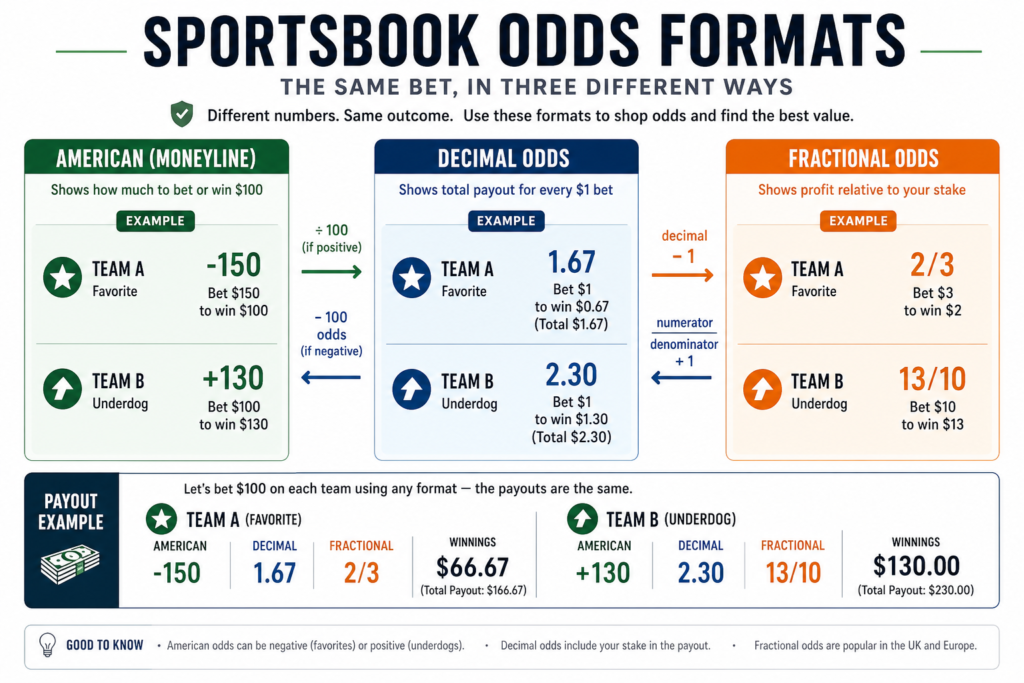
There are three main odds formats:
- American odds: common in the U.S.
- Decimal odds: common in Europe, Canada, and Australia
- Fractional odds: common in the U.K. and Ireland
All three formats represent the same underlying price. They just display it differently.
American Odds Explained
American odds use plus (+) and minus (-) numbers.
Negative Odds
Negative odds show how much you must bet to win $100 profit.
- -110 = bet $110 to win $100
- -150 = bet $150 to win $100
- -200 = bet $200 to win $100
Negative odds usually identify the favorite.
Positive Odds
Positive odds show how much profit you win from a $100 bet.
- +100 = win $100 on a $100 bet
- +150 = win $150 on a $100 bet
- +200 = win $200 on a $100 bet
Positive odds usually identify the underdog.
Quick American Odds Examples
| Odds | What It Means | Total Return on $100 Bet |
|---|---|---|
-110 | Risk $110 to win $100 | $190.91 on a $100 stake |
-150 | Risk $150 to win $100 | $166.67 |
| +150 | Win $150 on $100 | $250 |
| +200 | Win $200 on $100 | $300 |
Decimal Odds Explained
Decimal odds are often easier for beginners because they show your total return, including your stake.
- 2.00 = double your money
- 1.50 = $1.50 return for every $1 bet
- 3.00 = $3 return for every $1 bet
Example
If you bet $50 at 2.50 odds:
- Total return = $125
- Profit = $75
Fractional Odds Explained
Fractional odds show the ratio of profit to stake.
- 5/1 = win $5 for every $1 staked
- 2/1 = win $2 for every $1 staked
- 1/2 = win $1 for every $2 staked
Example
If you bet $20 at 5/1:
- Profit = $100
- Total return = $120
Odds Conversion Table
| American | Decimal | Fractional | Implied Probability |
|---|---|---|---|
-200 | 1.50 | 1/2 | 66.7% |
-150 | 1.67 | 2/3 | 60.0% |
-110 | 1.91 | 10/11 | 52.4% |
| +100 | 2.00 | 1/1 | 50.0% |
| +150 | 2.50 | 3/2 | 40.0% |
| +200 | 3.00 | 2/1 | 33.3% |
Implied Probability: The Hidden Meaning Behind Odds
One major content gap in many beginner guides is that they explain payouts, but not what odds imply about chance.
Odds also convert into implied probability.
Formula for Positive American Odds
Probability = 100 / (odds + 100)
For +200:
- 100 / (200 + 100) = 33.3%
Formula for Negative American Odds
Probability = absolute odds / (absolute odds + 100)
For -150:
- 150 / (150 + 100) = 60%
This matters because smart bettors compare the sportsbook’s implied probability to their own estimate of a team’s chances.
If you think a team has a 40% chance to win, and the book prices it at +200 implied 33.3%, that may represent value.
The Main Types of Sports Bets
A complete sports betting explanation has to go beyond odds. You also need to understand the actual bets.
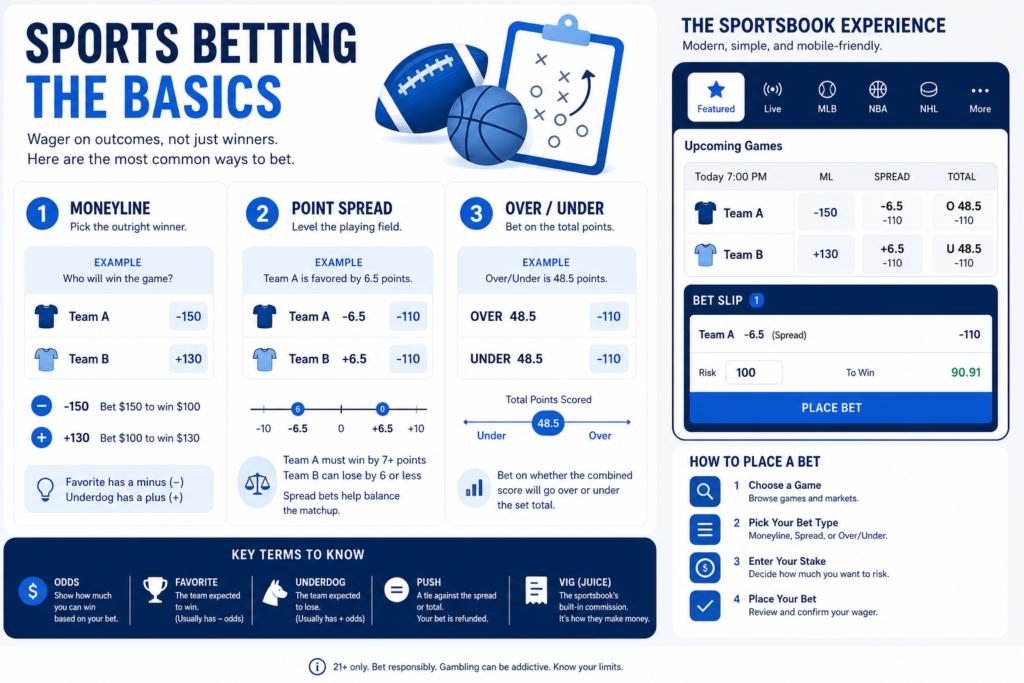
Moneyline Bets
A moneyline is the simplest bet: pick the winner.
Example
- Chiefs -180
- Raiders +155
If you bet the Chiefs, they just need to win the game. If you bet the Raiders, they also just need to win. No point spread is involved.
Best For
- Beginners
- Low-scoring sports like baseball and hockey
- Bettors who want simplicity
Point Spread Bets
A point spread evens out a matchup by giving the underdog points and making the favorite “lay” points.
Example
- Eagles -6.5
- Giants +6.5
If you bet the Eagles, they must win by 7 or more.
If you bet the Giants, they can either:
- Win outright, or
- Lose by 6 or fewer
Why the Half Point Matters
A spread like -6.5 avoids a tie, also called a push.
A spread of -7 can push if the team wins by exactly 7.
Totals or Over/Under Bets
A total bet asks whether the combined score will go over or under the sportsbook’s line.
Example
- Over 47.5
- Under 47.5
If the final score is 28-21, the total is 49, so the over wins.
Totals can also apply to:
- Team points
- Player props
- Period or quarter scoring
Prop Bets
A prop bet focuses on something other than the final outcome.
Examples include:
- A quarterback to throw over 1.5 touchdowns
- A striker to score anytime
- A basketball player to record a double-double
Props are popular because they let fans bet on players they already follow. At Sport Poient, this is where athlete analysis becomes especially useful: understanding usage trends, injuries, fitness, and matchup context can matter more than broad team form.
Parlays
A parlay combines multiple bets into one ticket.
To win the parlay, every leg must win.
Why People Like Parlays
- Bigger payouts
- More action from one ticket
- Fun for casual fans
Why They’re Riskier
- One loss kills the whole bet
- Sportsbooks usually hold more edge on parlays than single bets
Teasers
A teaser is a type of parlay, usually in football or basketball, where you move the spread in your favor but accept lower payout odds.
Example:
- Move a team from -8.5 to -2.5
- Combine with another adjusted line
Futures Bets
A future is a wager on something that will be decided later.
Examples:
- Team to win the Super Bowl
- Player to win MVP
- Club to finish top of the league
These are longer-term bets and odds can move dramatically during the season.
Live Betting
Live betting, or in-play betting, happens after the game starts. Odds change in real time based on:
- Score
- Time remaining
- Injuries
- Momentum
- Possession or field position
Live betting can create opportunities, but it also encourages impulsive decision-making if you’re not disciplined.
How to Read a Sportsbook Board
When you open a sportsbook, you’ll usually see columns for team names and different betting markets.
A basic football board might look like this:
| Team | Spread | Total | Moneyline |
|---|---|---|---|
Dolphins | -3.5 (-110) | Over 46.5 (-110) | -165 |
| Jets | +3.5 (-110) | Under 46.5 (-110) | +140 |
How to Read It
- Spread: Dolphins must win by 4 or more
- Total: Combined score must go over or under 46.5
- Moneyline: Pick the winner outright
What a Push Means
A push happens when the result lands exactly on the betting number.
Example
- Team A -3
- Team A wins by exactly 3
The bet pushes and your stake is refunded.
Pushes are common on:
- Whole-number spreads
- Whole-number totals
They do not happen on markets with half points, such as -3.5 or 47.5.
What “Juice” or “Vig” Means
Another thing many competitor articles mention briefly but don’t fully explain is why -110 is so common.
If both sides of a spread are -110, the sportsbook is charging a commission. That means you need to win more than 50% of these bets to break even.
Break-Even Rate at -110
At -110, you need to win about 52.38% of your bets to avoid losing money long term.
This is why even seemingly small price differences matter.
| Odds | Break-Even Win Rate |
|---|---|
-105 | 51.22% |
-110 | 52.38% |
| -115 | 53.49% |
| +100 | 50.00% |
Why Odds Move
Odds are not fixed. They move because sportsbooks react to new information and betting action.
Common Reasons for Line Movement
- Injury news
- Weather changes
- Starting lineup announcements
- Heavy betting on one side
- Sharp bettor action
- Public hype around a team
Example
If a star quarterback is ruled out, a team might move from:
- -4.5 to +1.5
That is a major shift because the sportsbook is re-pricing the team’s chances.
Closing Line Value: A Smarter Way to Think
A content gap in many beginner guides is the idea of closing line value, often called CLV.
This means comparing the number you got to the final market number before the game starts.
Example
You bet a team at +4.5.
By kickoff, the line is +2.5.
That means you beat the market by 2 points. Even if the bet loses, getting better numbers consistently is usually a sign of strong long-term process.
For readers who want to move beyond basics, this is one of the most useful ideas in sportsbook betting.
How Sportsbooks Balance Risk
Sportsbooks don’t always move lines just to get “equal money” on both sides. That’s a common oversimplification.
In reality, books often:
- Respect sharp action more than public action
- Move aggressively on injury or lineup information
- Shade lines toward popular teams
- Adjust limits by sport and market
So yes, risk management matters, but sportsbooks also price markets according to information quality and bettor behavior.
Common Beginner Mistakes in Sports Betting
If you’re searching for sports betting explained, chances are you also want to avoid rookie mistakes.
Betting Too Many Games
Most beginners think more bets means more chances to win. Usually it means more exposure to mistakes.
Chasing Losses
Trying to win back money immediately often leads to poor decisions and bigger losses.
Ignoring Price
A good team is not automatically a good bet. A lot depends on the price.
Betting With Emotion
Fans often overrate their favorite team or player. That’s why disciplined bettors separate fandom from analysis.
Not Understanding the Market
A bet can lose even if your read was solid. Focus on making good decisions, not just on short-term results.
A Simple Beginner Workflow Before You Bet
Here’s a practical framework Sport Poient readers can use.
1. Understand the Bet Type
Know whether you’re betting moneyline, spread, total, or prop.
2. Read the Odds Correctly
Translate the odds into payout and implied probability.
3. Check News and Context
Look at injuries, rest, travel, matchups, and recent form.
4. Compare Sportsbooks
Even a small change from -110 to -105 matters over time.
5. Set a Budget
Only wager what you can comfortably afford to lose.
6. Track Results
Record your bets, odds, stake size, and reasoning.
Bankroll Basics for Beginners
A strong sports betting explanation should include bankroll management, because understanding odds means little if your staking is chaotic.
What Is a Bankroll?
Your bankroll is the total amount of money you’ve set aside specifically for betting.
What Is a Unit?
A unit is a standard stake size, often 1% to 2% of your bankroll.
If your bankroll is $500:
- 1 unit might be $5
- 2 units might be $10
Using units helps prevent emotional overbetting.
Basic Rule
Do not dramatically increase stake size after a win or loss unless you have a clear, disciplined system.
Responsible Betting Matters
Sports betting should be treated as entertainment, not guaranteed income.
Important reminders:
- There is no such thing as a lock
- Short-term winning streaks can be misleading
- Even strong bettors lose often
- Never bet money needed for bills or essentials
Sport Poient’s approach is to make betting concepts easier to understand, not to glamorize reckless gambling. In the same way we explain athlete performance, recovery, and training with realism, we believe betting education should include risk awareness too.
Sports Betting Explained in One Example
Let’s bring everything together.
Sample Game
- Lakers -4.5 (-110)
- Warriors +4.5 (-110)
- Moneyline: Lakers -180, Warriors +155
- Total: 228.5
What Each Market Means
| Bet Type | Selection | What Must Happen |
|---|---|---|
Moneyline | Lakers -180 | Lakers must win the game |
Moneyline | Warriors +155 | Warriors must win the game |
Spread | Lakers -4.5 | Lakers must win by 5+ |
| Spread | Warriors +4.5 | Warriors can lose by 4 or win outright |
| Total Over | Over 228.5 | Combined score must be 229+ |
| Total Under | Under 228.5 | Combined score must be 228 or less |
That’s the clearest version of sports betting odds explained in action: one game, multiple markets, different prices, different paths to win.
How Sport Poient Helps Readers Go Beyond the Basics
Many betting guides stop at definitions. Sport Poient goes further by connecting betting knowledge to the broader sports picture:
- Match news and analysis that adds context to lines
- Athlete injury, fitness, and performance insight that can influence props and totals
- Simple explanations for confusing sports concepts
- Training, recovery, and sports culture content that makes the site useful beyond betting alone
If you want a sports media platform that covers both trending stories and evergreen explainers in accessible language, Sport Poient gives you more than just headlines.
Final Verdict
Understanding sports betting starts with four basics:
- Know the bet type
- Know how odds determine payout
- Know what probability the odds imply
- Know how sportsbooks build in an edge
Once you understand moneylines, spreads, totals, vig, and line movement, the betting board becomes much less intimidating. You don’t need advanced math to get started, but you do need clarity, discipline, and context.
That’s exactly where Sport Poient fits in. We help readers cut through jargon, understand the sports behind the odds, and stay informed with practical, readable coverage. If you want sports content that connects news, athlete insight, and betting education in one place, Sport Poient is worth adding to your regular reading list.
FAQ
What does a +200 odds mean?
+200 odds means a $100 bet would return $200 in profit, plus your original $100 stake. It also implies roughly a 33.3% chance of winning before sportsbook margin is considered.
What does +200 mean in sports?
In sports betting, +200 usually refers to American odds on an underdog or less likely outcome. If that bet wins, a $100 wager earns $200 profit for a total payout of $300.
What does +\- mean in sports betting?
The plus (+) and minus (-) signs show how American odds work. A minus number tells you how much to risk to win $100, while a plus number tells you how much profit you make on a $100 bet.
What does a +200 mean?
+200 means the sportsbook will pay $200 in profit for every $100 staked if the bet wins. It is commonly used to price an underdog or a less probable result.
What does a +200 mean?
In practical terms, +200 means your wager would win at a 2-to-1 profit ratio in American odds format. A $50 bet would profit $100, and a $100 bet would profit $200.
What chance is +200 odds?
+200 odds imply about a 33.3% probability. The formula is 100 divided by the odds plus 100, so 100 / 300 = 0.333.